Collect More Income From the Savings You Already Have,Without Selling What You Built.
It’s the strategy I use on my own money. I’ve never found a year when doing nothing came out ahead.
 From the Desk of Robert RapierChief Investment Strategist, Utility Forecaster
Dear Member,
The Income Strategy I’ve Built My Own Financial Security On
I grew up poor in southeastern Oklahoma.
All four of my grandparents retired with nothing but Social Security. I watched what that meant for them.
In ninth-grade algebra, a teacher explained compound interest, and something clicked.
A poor farm kid with enough years and a decent return could build real wealth. I’ve been obsessed with getting more income from every dollar ever since.
That obsession led me to the strategy I want to show you here. Over the years, it has made me financially secure.
It’s my bread and butter. I use it on most of the stocks I own, and on the spare cash in my brokerage account.
You may know me from Utility Forecaster, the income newsletter I’ve run since 2018. I don’t chase fads, and this isn’t one.
I’ve used it on my own money for years. Since April 2021, I’ve shared it with members of Rapier’s Income Accelerator.
My goal is simple. Even if you never join, you’ll leave knowing how to collect more income from the savings you already have.
What I Check Every January 1
Every January 1, I sit down with my own accounts. I ask one question: would I have been better off doing nothing?
I add up the income I collected that year. I subtract the gains I gave up when a stock rose past the price I’d agreed to sell at.
Then I compare that with what the same stocks would have done if I’d left them alone.
The answer has never changed. I have never found a year in which leaving my portfolio alone would have produced better results.
| 2022: the S&P 500 | −18.1% |
| 2022: the account I used only for this | +0.21% |
| 2023: my five accounts using it, compared with doing nothing | 2% to 10% better |
2022 was the real test: that account finished slightly ahead in a year when the market gave up nearly a fifth of its value.
At the end of 2023, all five of my accounts did better with it than without it.
That’s my own money, not a promise about yours. But it’s why I’m comfortable showing you how it works.
What It Could Mean for You
Here’s what that looks like from your side of the table.
- Income that arrives up front, the day you act, instead of once a quarter.
- Income mostly from steady, dividend-paying companies.
- Income that doesn’t require you to sell a single share of what you’ve spent a lifetime building.
If your savings produce less than you’d like, that’s the opportunity. Most retirees never get to it, for three reasons.
The 4% Rule Only Works if You Keep Selling
If you’ve saved carefully and the income still falls short of the bills, you’re in good company.
Most retirees hear the rule of thumb sooner or later: take out 4% a year, and the money should last.
Run the numbers, and they’re sobering.
| A $1 million portfolio under the 4% rule | $40,000 a year |
| A $500,000 portfolio living on a 3.5% dividend yield | $17,500 a year |
And the 4% rule assumes you sell. Every year you live on it, you cut away a little more of what pays you.
A reader put it to me plainly a while back. He’d saved what he could, but 4% still didn’t cover the bills.
I asked him one question: “What if it was 8%? Would that be enough?”
“Sure,” he said. “That would probably be enough.”
“But where am I going to find yields that high? Isn’t investing in high-yielding stocks riskier?”
The Obvious Fix Does the Most Damage
He was right to worry. The usual answer is to buy stocks with bigger dividends: 6%, 8%, even 9%.
But yields are usually high for a reason. The market doesn’t believe the payout will last.
When a dividend gets cut, the share price tends to fall with it. Years of income can vanish in a single morning.
The Word That Stops Most Income Investors Cold
I wasn’t talking about riskier stocks. I meant the strategy I use myself.
When I explained it, he gave me an answer I’ve heard many times since:
“Oh, I would never trade options. They’re too risky.”
If that was your first reaction too, I understand. In my experience, it keeps more income investors stuck at 4% than anything else.
And he was half right.
Sit Where the Casino Sits
Buying options as a bet is a lot like walking into a casino. You pay a little for a shot at a big win, and over time most people lose.
But every bet has someone on the other side, collecting the money up front. That’s where Rapier’s Income Accelerator sits.
We never buy options as a bet. We sell them, and usually buy them back cheaply once most of the money is made.
Don’t be the gambler. Be the casino.
It takes only basic options approval, the most conservative tier a broker offers. Most brokers call it Level 1; a few call it Level 2.
Most brokers grant it within a day or so. It’s allowed in most traditional, Roth and SEP IRAs.
There’s no margin and no borrowed money. Every position is backed by cash or shares you actually hold.
That’s the answer I gave him. Take Cisco, bought the month the service launched.
For four and a half years, its dividends plus the income from selling options came to more than 8% a year on what we paid.
If you’d rather skip the explanation, here’s the member offer.
How $600 Landed in Members’ Accounts the Day They Placed One Order
Think about the cash sitting in your money market right now. Here’s what a real recommendation from this spring did with cash like it.
On May 2, I wrote to members about Voya Financial (NYSE: VOYA), a retirement and benefits company. We had done well with it once before.
Voya traded at $82.60. I recommended agreeing to buy 100 shares at $80, any time before November 20.
That agreement is called a put. Members collected at least $6.00 a share for selling it, or $600 for each contract of 100 shares, the moment the order went through.
Members who reported their orders got $7.10 a share. That money was theirs to keep, whatever happened next.
From there, one of two things could happen.
#1 If Voya Stays Above $80
- The put expires.
- Members keep all the money they collected, called the premium.
- The cash never leaves their account, and keeps earning interest.
#2 If Voya Falls Below $80
- Members buy 100 shares at $80.
- With $6.00 a share already collected, the real cost is $74.
- That’s about 10% below where Voya traded that day.
- If Voya had fallen below $74, the shares would start out worth less than that.
As it turned out, neither happened. Voya moved up, and by mid-July most of the premium was earned.
I recommended buying the put back early, and the order filled in early August.
Voya: $570 kept, and the $8,000 never left the account
- May 2Recommended
- May 4Order filled
- Aug. 6Bought back
Recommended May 2, 2026. Members’ confirmed fills: $7.10 a share. Bought back August 6, 2026, at $1.40 a share. One contract, before taxes. Source: portfolio tables.
Then that cash was free for the next one.
I built that recommendation with new members in mind. The goal was enough cash in the first week to cover most of a year’s membership.
Keep that in mind; I’ll come back to it.
This is called a cash-covered put. The money to buy the shares sits in your account the whole time, and nothing is borrowed.
Think of it as insurance. The buyer pays for protection against a falling price, and we’re the insurance company collecting the premium.
Most of the time no claim is filed. When one is, we buy a stock we wanted, at the price we agreed.
By then the stock has fallen, so the shares can start out worth less than we paid.
The other half of the service sells covered calls on shares the portfolio already owns. It’s a lot like renting out a house you own.
You collect the rent up front. If the tenant moves out, you keep the house and the rent, and rent it out again.
If the tenant buys the house, you sell it at the agreed price and still keep the rent.
Five Years of Income, Every Position in the Open
I launched Rapier’s Income Accelerator in April 2021. Every recommendation since sits in our portfolio tables, winners and losers alike.
Source: portfolio tables, October 20, 2026. Half the finished puts did better than 17.1%; 152 of the 160 reached 10% or better.
220 positions finished since April 2021. One closed at a loss.
Each square is one finished position.
160 cash-covered puts · none lost money on the option itself
60 covered-call positions · 59 closed with a profit
Apartment Income REIT: bought out below cost and closed July 2024 at a 6.7% loss. The only position closed at a loss since launch.
Source: portfolio tables, October 20, 2026. Puts that end in a share purchase can start out below cost; those positions appear in the losses section below.
Besides my own accounts, I tally the service’s cash-covered puts at the end of each year.
I watch the return on the money at risk, worked out over a full year. It lets you compare a five-month position with a bond or a CD.
Every year, the puts averaged above my 10% target
Average return on the money set aside, per closed position, worked out over a full year
Most conservative countAdded by a few unusual positions2026 from the portfolio tables, before the year-end tallyTarget: at least 10%
Sources: Robert Rapier’s reviews of April 16, 2022; January 2, 2023; January 1, 2024; December 28, 2024; and January 3, 2026. 2026: portfolio tables as of October 12, 2026, before the year-end tally; half the 2026 positions did better than 20.4%. Each figure averages closed positions’ returns, worked out over a full year. It excludes interest on the cash, time the cash sat idle between positions, and any later gain or loss on shares bought through a put. The first year overlaps the start of 2022.
In the 2022 bear market, the service’s puts still averaged 11.8% worked out over a full year. That’s by my own most conservative count.
The covered-call side didn’t finish positive, unlike my own account. Counting premiums and six closed positions, it finished down 2.2%.
As I told members that January: “That’s still not a gain, but it’s a lot better than the nearly 20% loss of the S&P 500.”
A few of the positions behind those numbers:
| Company | What we did | When | Result |
|---|---|---|---|
| Cisco Systems (NSDQ: CSCO) | Covered calls on the shares, 11 in a row | Apr 2021 – Dec 2025 | +52.9% over 4.6 years, about 11.5% a year |
| Gilead Sciences (NSDQ: GILD) | Puts until we bought, then calls | Dec 2022 – Sep 2025 | Bought at $72.20 effective, sold at $87.50; +34.0% with dividends and call income |
| Suncor Energy (NYSE: SU) | Covered calls, 7 in a row | Sep 2022 – Nov 2025 | +46.9% in total |
| Cisco Systems (NSDQ: CSCO) | One cash-covered put, closed early | Apr 13 – May 18, 2026 | +5.6% in 35 days; about 58% worked out over a full year |
| Voya Financial (NYSE: VOYA) | One cash-covered put, closed early | May – Aug 2026 | Kept $570 a contract; 30.4% worked out over a full year |
Members in Their Own Words
This spring I asked members how it’s gone. A few of their answers:
“I trusted you because I had subscribed to Utility Forecaster previously for several years… Now I have covered calls on nearly all my stocks (in addition to many of your recommendations) and have effectively doubled or tripled my income… I have learned much more about the process thanks to you and have applied that knowledge to other stocks. I have increased my income by $50,000 a year using this knowledge. This number is in addition to dividends or interest.”
A longtime subscriber · April 2026
“I’m not a retiree yet, but I am getting close! I subscribed to the Income Accelerator when you started the service in 2021. I liked your conservative approach… I appreciate how you methodically explain each situation with every trade. It helps me understand the reasons for each trade which gives me confidence and trust needed when things get ‘volatile.’ Last year the income I was able to produce was $25,870 thanks to your service.”
Randall T. · member since 2021
“It’s a good way to collect extra income, and the recommendations come with clear instructions. I like the approach of using both puts and calls.”
Mark S.
“[Your] service is profitable… and easy to follow… Thank you again: for the trades, caring about your subscribers and educating us.”
Maria R.
Members’ own reported results, in their own words, spring 2026. These results are not typical. Results vary with the number and size of positions; some members also apply the method to stocks of their own.
The Positions That Didn’t Work, and What I Did About Them
You’d be right to be suspicious of any record without a few losers. Ours has them, in the tables for every member to see.
| Position | What happened | Result |
|---|---|---|
| Apartment Income REIT | Owned from July 2021, with calls sold against it. Bought out below our cost before it recovered. | A 6.7% loss, closed July 2024. Our only closed loss. |
| Sturm Ruger | Held more than four years while the stock fell by about half. Premiums and dividends kept it just ahead. | About 1% a year. Not a loss, but not what I wanted. |
| Covered calls opened in 2025 | Mostly stocks bought through puts, which start out underwater. “We will continue to work methodically to recover that ground.” | The 14 positions ended 2025 down 14.2% on average. |
| The years the market sprints | In 2023 the S&P 500 returned 24.2%. Selling calls caps the gain when a stock takes off. | Our portfolio as a whole lagged. I said so at the time. |
When a position goes against us, I don’t close it at a loss to make the table look cleaner.
I keep selling calls against it, collecting income while it works its way back. As I’ve told members: “I believe in working our way out of these losses.”
This isn’t a strategy that never loses. It collects income on nearly every position and keeps its losses small and in the open.
Then it repeats the same high-probability move, over and over.
The Five Rules Behind My Recommendations
I don’t do this on just anything. These rules guide what I recommend.
When I make a more aggressive trade, I say so in the issue.
Rule one
The company comes first
It must pass my screen: dividend-paying, steadier than the market, with the cash flow to keep paying. Of more than 9,000 stocks, about 100 pass in a typical week.
Rule two
The numbers have to work
A double-digit return on the money at risk, worked out over a full year. And under a 40% chance of buying the shares; Voya’s was 38%.
Rule three
I take the risk off early
When about 80% of the premium is earned with two months to go, I close the position. The cash moves to the next one.
Rule four
I don’t rush to lock in losses
When a stock falls toward our price, I often roll the position: buy back the option and sell a new one further out, for more income.
Rule five
I keep positions small
No more than 3% to 4% of your portfolio in any one position. Never margin.
I use the same screen on my own portfolio. As I told members our first summer, it’s “full of companies chosen by the same rules.”
I close my own puts early by the same rule. And I’d never recommend anything that puts my interests ahead of yours.
20 to 30 Minutes on a Saturday, and About a Minute to Place an Order
Here’s what you’d actually do each week.
Saturday afternoon
Your issue arrives
What moved, where every position stands, and any rolls or closes due. Often one new recommendation, with exactly what to enter and what to tell your broker.
About a minute
Placing an order
Choose the option, enter the limit price and number of contracts, and submit. It gets quick after a few times.
20 to 30 minutes
Reading the issue
Depending on how closely you like to follow my reasoning.
Every week
I keep the books
Every position, premium and dividend goes into our online tables, so you never need a spreadsheet. I record each one once members confirm their fills.
Your first Saturday
The Starter Kit
The five current positions I’d begin with, each with the exact order. Pick one, place it, and read along as it works.
The Questions I Hear First
“Do I have to sell the stocks I already own?”
No. You can start with cash sitting in a money market, one position at a time.
Rapier’s Income Accelerator is its own pool of money. It sits beside what you own instead of replacing it.
“I’m retired. I don’t want another job.”
You won’t have one: one issue on Saturday, a minute per order, and I keep the books.
There’s no pressure to take every recommendation. Plenty of members start with one position and add more over time.
“Is this safe for someone my age?”
No investment is free of risk, and I won’t pretend this one is. The real risk is the same as owning any stock: a sharp fall.
Selling options lowers what you pay for a stock; it doesn’t remove the risk.
So we mostly stick to steady dividend payers, keep each position to 3% to 4% of your portfolio, and never use margin.
“How much money do I need?”
Recent positions needed about $2,000 to $8,000 set aside per contract; Voya needed $8,000.
At no more than 3% to 4% of your portfolio in any one position, the larger ones, like Voya, suit savings well into six figures. Smaller ones let you start with less.
“Can I do this in my IRA? What about taxes?”
Yes. The approval we need is allowed in most traditional, Roth and SEP IRAs; the Broker Script Vault lists what each broker calls it.
In a taxable account, premiums are taxed as short-term gains, so many members prefer an IRA. Check with your tax advisor.
“What happens if I have to buy the shares?”
You buy 100 shares of a stock that passed my screen, at the price we agreed. That’s below where it traded the day we started.
But the stock has fallen to get there, so the shares often start out worth less than you paid.
Then we sell covered calls on them for income while we wait. The covered-call positions opened in 2025, mostly shares bought this way, ended that year down 14.2% on average.
In 2025, 7 of the 30 puts we closed ended that way; so far in 2026, 6 of 29.
Why Waiting Costs More Than You’d Think
There’s no deadline on this offer. It’s a standing rate for Investing Daily members.
But two things are worth knowing.
First, money-market cash is earning less than it did. Money-market funds paid around 5% in 2023; my own Fidelity sweep paid about 3.3% in May 2026.
Cash set aside behind a put still earns that interest, plus the premium. Every idle month is a month of premium nobody collected.
Second, the income comes from repetition. One position earning 5% to 10% over a few months may not look like much.
Repeat it through the year, and it adds up. The sooner the first one is placed, the sooner the next can follow.
Two or Three Typical Positions Would Cover the Year’s $795
Remember Voya? At the $7.10 fill, it put $710 a contract in members’ hands the week many of them joined.
They kept $570 of it: most of a year’s membership from one position.
Voya was a good one. Here’s the typical math I’d want to see in your chair.
Two typical positions cover your first year
Dollars per contract, collected the day the order fills
Closed early, as most are, it usually takes three.
$410: median premium on the 36 new cash-covered puts in the 12 months to October 20, 2026. One contract each, before buyback costs and taxes; each needed about $2,000 to $8,000 set aside. Source: portfolio tables.
That takes two or three contracts’ worth of cash set aside, about $2,000 to $8,000 each. Kept, the premiums would have covered the membership.
After that, the premium goes to you, not to the membership.
I can’t promise what you’ll collect. It depends on how much cash you put to work and which positions you take.
But think about what steady extra income is actually for.
- A grandkids’ college fund you can add to without drawing down your principal
- The trip with your spouse you keep putting off
- Living on what your savings produce, instead of selling them off a little more each year
Everything You Get, Starting This Saturday
A full year of Rapier’s Income Accelerator:
52 weekly issues, most on Saturday, with every open position and each new recommendation
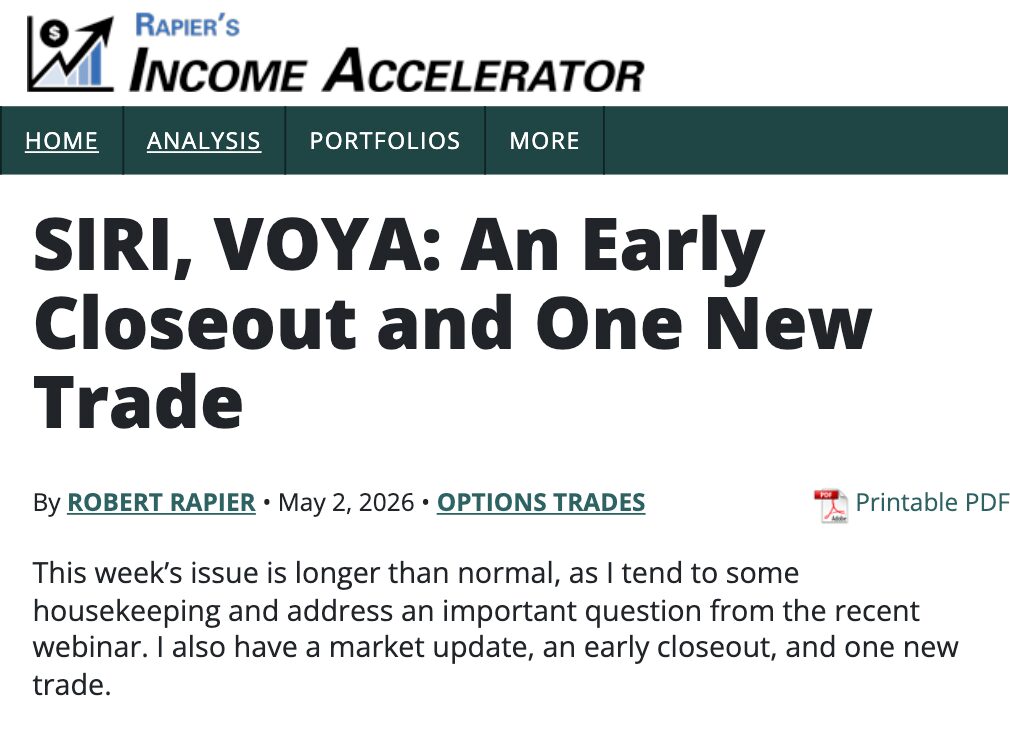
The May 2, 2026 issue, which recommended Voya.
Both portfolios online, every closed position on record, updated weekly
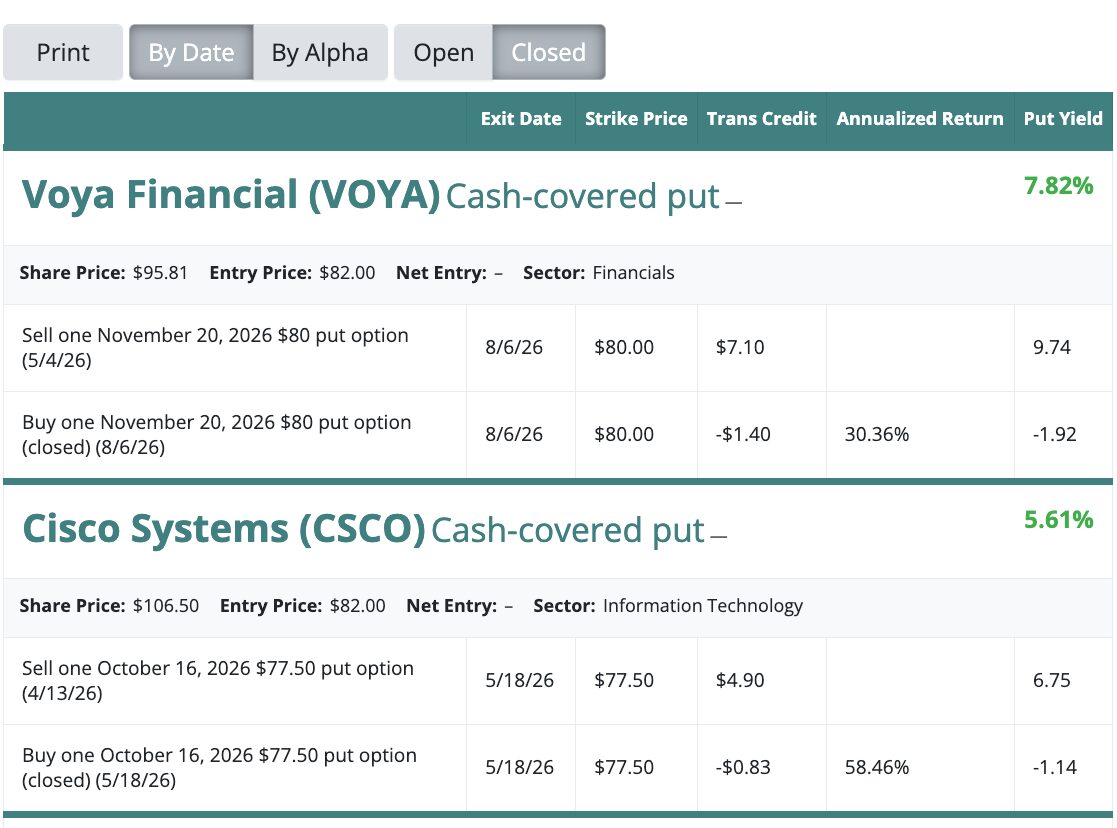
Closed puts, October 2026. Open positions are visible to members only.
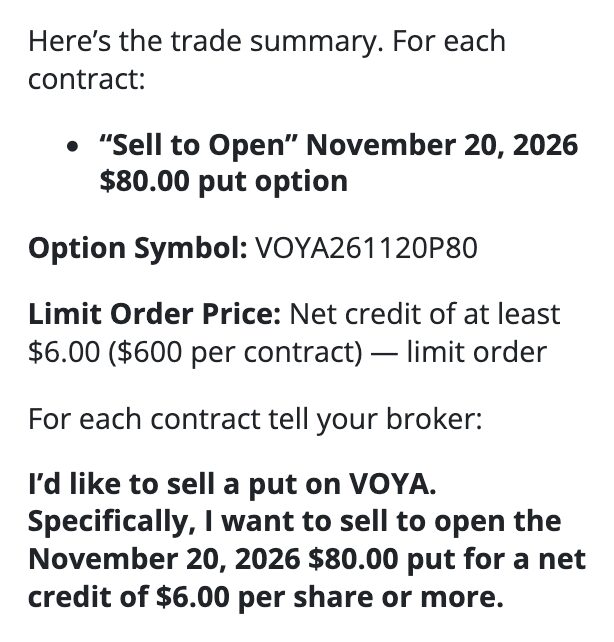
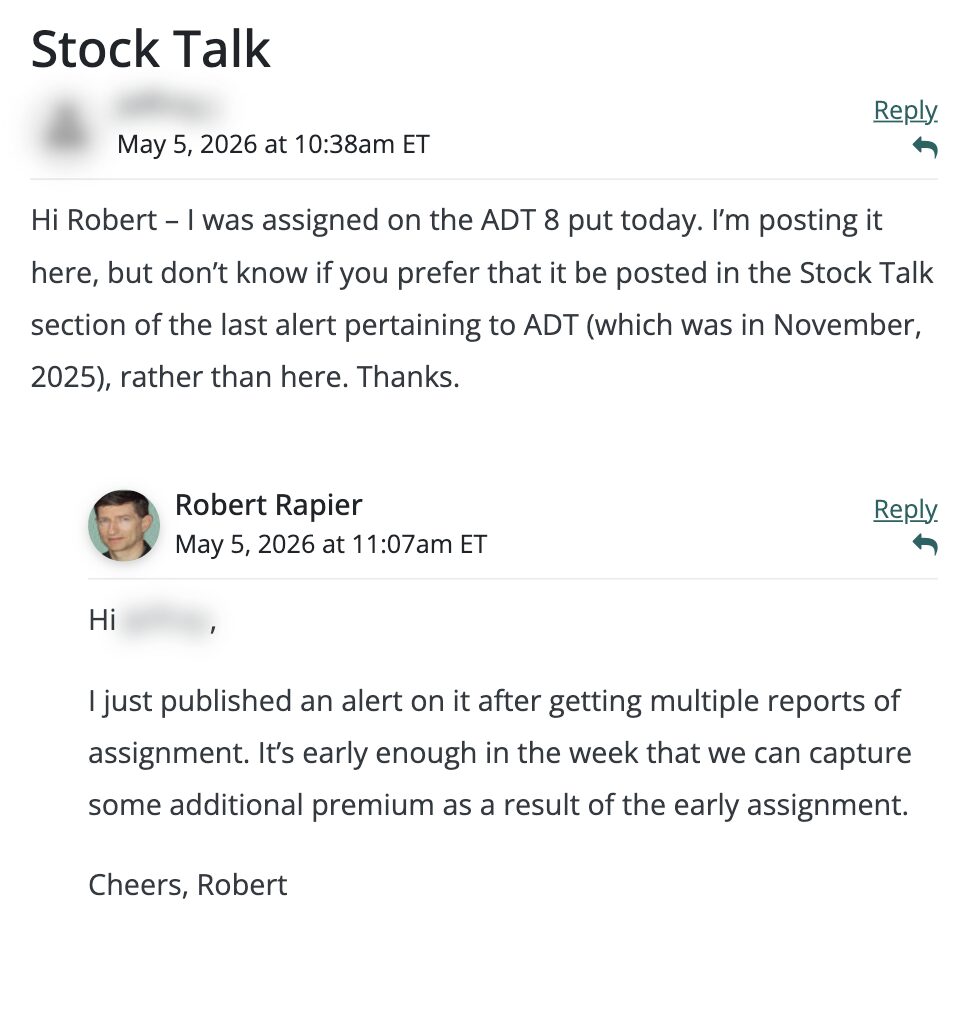
Pictures enlarge when tapped.
Plus Four Bonuses, Yours to Keep

The Starter Kit
Your first trade, ready to place: five current positions, each with the exact order.
The Broker Script Vault
Never stuck at your broker’s screen: click-by-click order steps for six major brokers, plus what to say by phone.
The 2025 Trade Journal
Our latest full year, trade by trade: every position closed in 2025, with my notes from open to close.
How Covered Calls Actually Work
The covered-call half of the service, in plain English and one short read.
Keep What You Built
I’ll be honest: I’m not a salesperson, and I don’t like this part. I’d rather tell you plainly who this is for.
If your whole portfolio is around $5,000, it isn’t the right fit yet.
If you want maximum growth and can’t stand seeing a stock sold at an agreed price, it isn’t for you either.
But if you’re like a lot of our members, you spent decades building what you own. You shouldn’t have to sell it off to live on it.
And you don’t need to become a trader to make it produce more.
You need cash set aside, a few minutes on a Saturday, and the patience to let the odds work for you.
It’s how I handle my own money. I’d be glad to show you how to handle yours.
After the first year, your membership renews at the standard $995 a year unless you cancel. Cancel any time.
Will $795 pay for itself? Two or three typical positions, kept, would cover it.
What you collect depends on the positions you take.
30 Days to Decide
Read four Saturday issues and look through every position. Place an order or two if you’re ready.
If Rapier’s Income Accelerator isn’t right for you, email customerservice@investingdaily.com within 30 days for a full refund. The bonuses are yours to keep either way.
Your Membership Includes
- 52 weekly issues
- Exact instructions on every recommendation
- Both portfolios and weekly tables
- Stock Talk and Robert’s email
- The Starter Kit, your first Saturday
- The Broker Script Vault
- The 2025 Trade Journal
- How Covered Calls Actually Work
To your investing success,
More Questions Members Ask
What’s a “roll”?
Buying back the option you sold and selling a new one further out, in one order, for more than the buyback costs.
It avoids buying shares we don’t want yet, or collects more income.
Can I use my broker?
Almost certainly. I place my own orders at Fidelity, and the Broker Script Vault covers six major brokers.
Should I use margin?
No. Margin is how a market crash wipes out an account; every position here is backed by cash or shares.
How long does a position last?
Puts usually run a few months; the typical one lasted about five. Covered-call positions run longer.
Is this like the newsletter I already read?
It’s a different service with a different job. Our income newsletters find stocks to own and hold for years.
Rapier’s Income Accelerator collects income by selling options on companies that pass its own screen. The two lists sometimes share a company, for different purposes.
What happens after the first year?
Your membership renews at $995 a year unless you cancel. Cancel any time through customer service.