$11,230 Went Into This Company in 1994. It Has Paid Out $58,284 in Cash Since — and the Shares Are Still Worth More Than $91,000.
Now AI has made power the scarcest thing in America, and the dividend stocks that own it are my top recommendations today.
Robert Rapier
Chemical engineer · energy investing expert Chief Investment Strategist, Utility Forecaster — published continuously since 1989
It is one of the essential-service companies I follow — an electric utility, as it happens. It has raised its dividend 25 years running and hasn’t missed a quarterly payment since 1948. And artificial intelligence just made what it sells the scarcest thing in the American economy — which is why its industry is about to spend $1.4 trillion, and is allowed to earn a regulated return on the capital it puts in the ground.
I’m going to give you its name and ticker below. Free. No credit card, no email address, nothing asked in return.
You have already been billed for the first installment
In about eighteen months, the single largest industrial customer in the history of the United States showed up and asked to be connected to the American electrical grid.
You are already paying for it.
The average American residential electricity rate rose to about 18 cents a kilowatt-hour this year, and last year’s increase ran more than twice the rate of inflation. Across the last three capacity auctions at PJM — the market that sets wholesale power costs across 13 states and the District of Columbia — forecast data-center load added about $21.3 billion to what other customers pay.
That is not a prediction about what artificial intelligence will do to the power system. It is a line item on the bill on your kitchen counter.
The only question this letter answers is which side of that bill you would rather be on.
Because for most of your investing life, this entire category — the power companies, the pipelines, the water systems, the telecom carriers — was a bond substitute. You bought it because it paid 4% and it didn’t move much. Nobody put one in a retirement account expecting to make money on the share price. Demand for electricity in America grew at roughly zero for two decades — efficiency cancelled out population growth almost exactly, and a business selling more of nothing doesn’t grow. The pipelines and the phone companies got priced the same way. Safe. Dull. Ignored. Essential to everything, interesting to nobody.
That is the corner of the market the largest customer in American history just walked into — and it doesn’t only need electricity. It needs the gas to make it, the pipe to move it, the water to cool it, and the fibre to carry what comes out.
Every one of those dollars is chasing a socket
Artificial intelligence does not run on software. It runs on electricity.
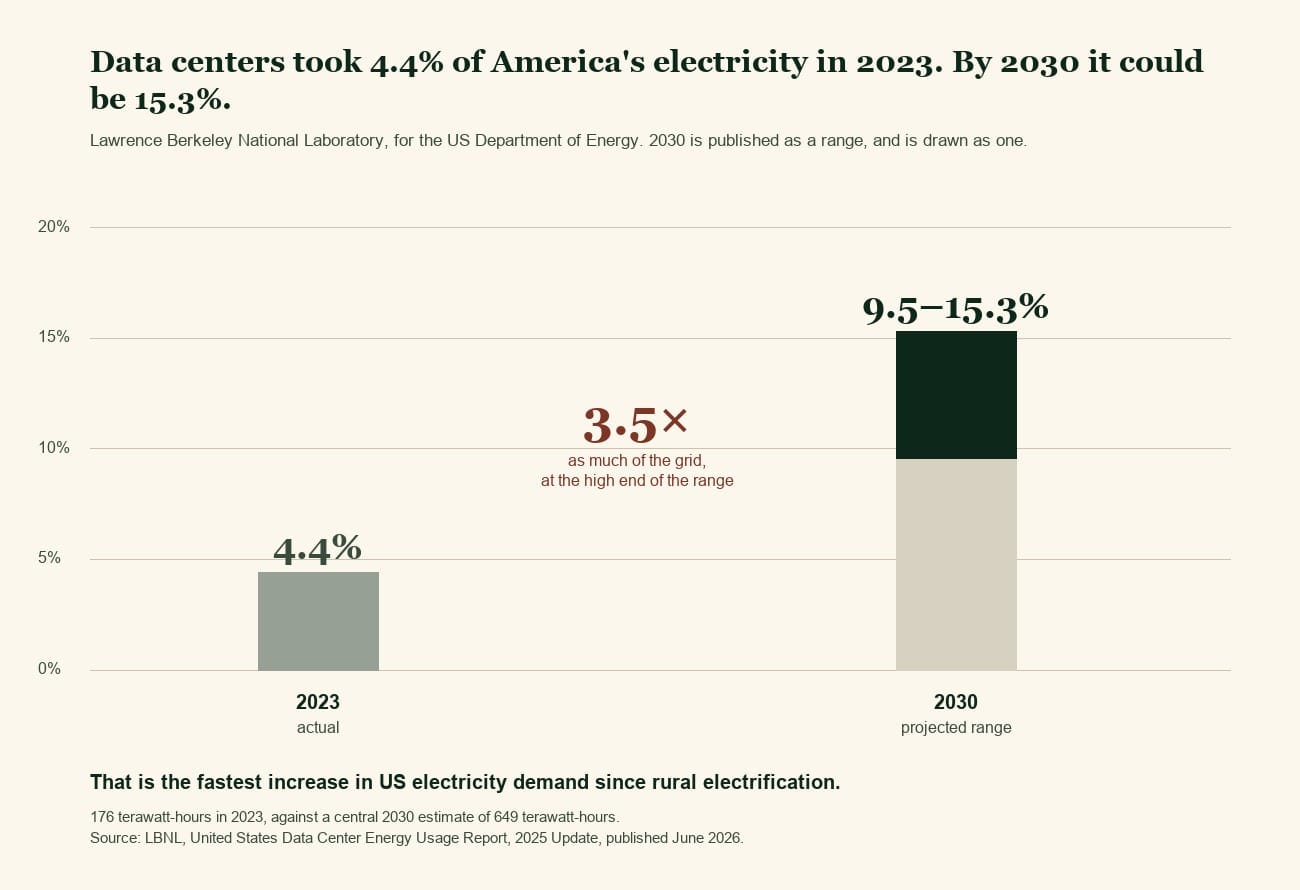
Data centers consumed about 4.4% of America’s electricity in 2023. The Department of Energy’s own national laboratory now projects 9.5% to 15.3% by 2030.
The 2030 figure is published as a range, so it is drawn as one. A single line through a projection is how charts mislead.
And the companies buying it are not ordinary customers. Amazon, Alphabet, Microsoft and Meta have guided to roughly $730 to $750 billion of capital spending this year alone. Amazon’s chief executive said that even at that number, “we will still not have enough capacity to meet all the demand we have in 2026.”
None of that is a forecast. Those capital budgets were published this summer, and the money is already committed.
One campus. Richland Parish, Louisiana.
One customer needs ten new power plants
Not ten power plants for a city. Not for a state. For one customer.
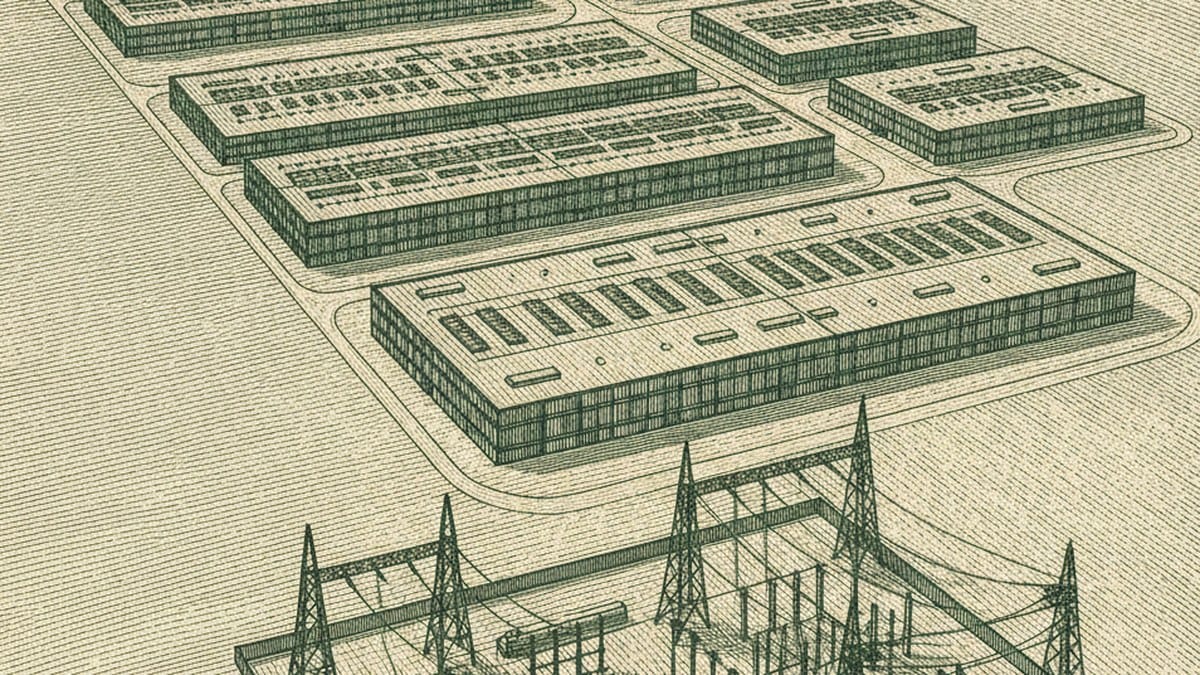
The campus is measured in millions of square feet and will draw enough electricity to run a mid-sized American state. To supply it, the local utility has asked to build ten new gas plants from scratch — three already approved by the state commission, seven more due for a decision in December. More than triple the original plan.
Ten. For one customer.
And here is the part almost nobody outside this industry understands — the part that turns somebody else’s construction bill into your income.
When a regulated utility spends money, that is not a cost. It is how the company grows.
A utility can’t set its own prices. It has to go to a state commission and ask. The conversation goes like this: we need to build this substation. The commission checks the work. If it agrees the substation is needed, it approves the spending — and it sets the return the company is allowed to earn on it, for as long as the asset exists.
So approved construction isn’t a bill. It’s an earnings stream with a regulator’s signature on it. Build more approved infrastructure, earn more. Every year.
That is how a regulated utility normally grows: approved construction goes into its rate base — the industry’s term for the capital a utility has in the ground and earns a return on. Louisiana shows who holds the cards: Meta is covering much of the cost itself, upfront, and the utility still ends up owning the plants. How much lands with other customers is in front of that commission right now, and unresolved. Which is itself a live demonstration of the mechanism: everything turns on what the regulator allows.
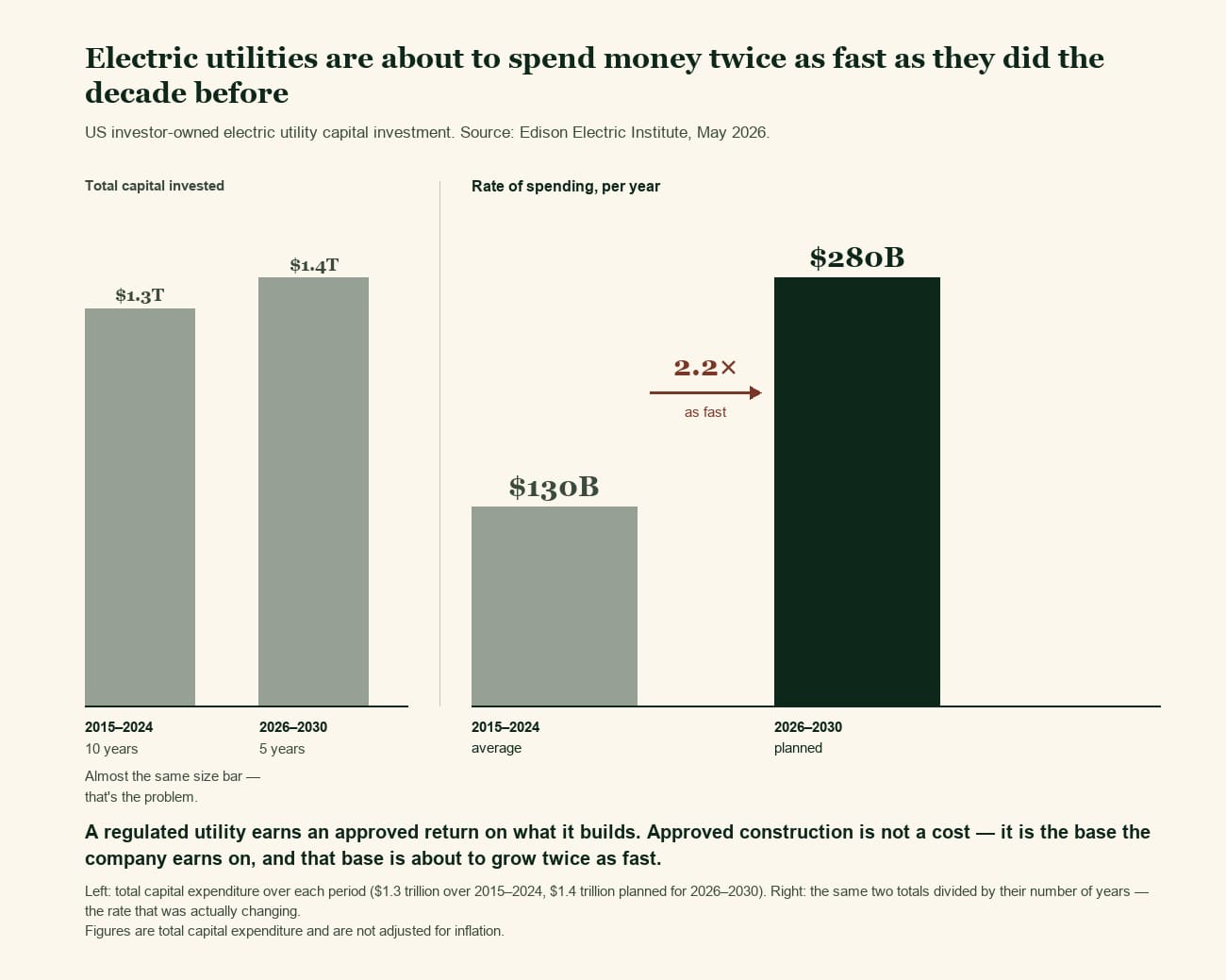
Now put a number on how much building is coming. The Edison Electric Institute is the trade association of America’s investor-owned utilities.
More in five years than in the ten before it — into an earnings base that earns an approved return.
State commissions are approving pieces of that $1.4 trillion right now, this quarter. Each approval is an earnings stream that did not exist last year.
That is the largest expansion of the American power business since the country was first electrified — and it is happening to a group of companies the market spent forty years pricing as though nothing ever would.
And they cannot go around the companies that own the sockets
This is the part almost nobody works through, and it is the whole difference between a story and a position.
The obvious move for a company with $220 billion to spend is to build its own power. They’re trying. It isn’t working, for three reasons that are not going away.
01
You can’t jump the queue
To connect anything to the American grid you join an interconnection queue. In 2008 the average project took 22 months from request to switch-on. For projects that came online in 2024 it was 55 months — four and a half years. The AI race will be substantially decided inside four and a half years.
02
You can’t buy the machines
Only a handful of companies on earth build heavy-duty gas turbines at scale. GE Vernova’s gas-power backlog reached 116 gigawatts by July — over half of it in reservation agreements rather than firm orders — and it expects to end this year mostly sold out of production slots through 2030. Siemens Energy is sold out through fiscal 2028.
03
So they’re signing contracts
In January, Meta announced agreements for up to 6.6 gigawatts of nuclear power through 2035. Microsoft signed a twenty-year deal with Constellation to restart a reactor at Three Mile Island. And in July one Georgia utility signed a twenty-five-year agreement to deliver 3.2 gigawatts to OpenAI’s first self-designed campus.
Read those terms again. Twenty years. Twenty-five years. Every one of them signed inside the last two years, by the richest companies in the world, with the incumbent owners of American generation — at prices set before anyone knew what an artificial-intelligence model would be worth. They run into the 2040s.
You do not have to guess which AI company wins. Whichever one does, it has already signed a contract with this same small industry.
A word about who is telling you this
I didn’t learn any of this from a press release
You’re about to read me explain how a utility actually makes money, and you have no reason yet to take my word for it. So here is where the word comes from.
I’m a chemical engineer. Bachelor’s degrees in chemistry and mathematics, a master’s in chemical engineering. Before I wrote a line of investment research I spent my career working in the energy business — efficiency work at a Texas petrochemical plant, then six years with ConocoPhillips managing research projects, a stint at a Montana refinery, leading a team of engineers in Scotland, and overseeing oil and gas operations in the North Sea. Later, engineering director for a Dutch environmental firm, and chief technology officer for a German entrepreneur, doing technical due diligence on energy projects around the world.
Along the way I picked up five patents. One of them is number 7,074,977 — a process for turning ethane into ethylene. You can look it up. I mention it because it is the kind of thing you cannot fake and it takes you about thirty seconds to check.
That is an unfashionable background for this job, and right now it is the only one that matters. Most of the people writing about artificial intelligence and electricity this year arrived from finance in the last eighteen months and are reading the same press releases you can read. I came at it from the other end — a career on the physical side, on fuel and turbines and pipe and permits and interconnection dates, years before anybody connected any of it to a data center.
Being asked about energy on 60 Minutes.
I started writing about energy publicly in 2005. Since then I’ve written for The Wall Street Journal, The Washington Post, The Christian Science Monitor and The Economist, and I currently write seven columns a month for Forbes. When 60 Minutes wanted somebody to explain the economics of fuel on camera, that’s the chair I was sitting in.
None of it was written for a bull market in power. It was written because the physics is the physics — and the physics is what just became scarce.
Utility Forecaster has been published continuously since 1989. I took it over on July 1, 2018, which means I did not buy the oldest positions in it. Analysts before me did. What I’ve done is refuse to sell them, re-underwrite every one, and answer for all of them in print every week since.
Now the part that actually matters, which is what I do with all of that.
I read financial statements the way I used to read a process flow diagram. A plant either balances or it doesn’t. Cash comes in, cash goes out, and the equipment either has the capacity to do what you are asking of it or it fails somewhere you can predict if you are paying attention.
Companies work the same way. So every month I go through the same unglamorous exercise on nearly 390 businesses that supply something the economy cannot function without — the power companies, yes, but also the pipelines that move the gas, the transmission owners, the water utilities, the telecom carriers and tower operators, the storage and terminal businesses. I look at whether the cash flow actually covers the dividend, whether the balance sheet survives the next rate cycle, and whether the regulator is likely to let them earn what they are asking to earn.
Then I rank them, publish a price above which I would stop buying each one, and tell you which ones I would put new money into first this month.
That is the entire job, and it is much closer to engineering than it is to forecasting. I am not predicting what artificial intelligence will do. I am reading the capital plans of the companies that have to build for it, the same way I once read them from the inside.
I’m not here to sell you artificial intelligence. I’m here to sell you the part of it that gets built whether the bubble pops or not.
“I really trust Robert Rapier. I believe he puts the investor’s best interest first, he does extensive research, and he wants the investor to be successful.”
Anna Kunze · subscriber survey, 2021
So why not just buy the index and be done with it?
That is the obvious response to everything I have just told you, and I want to deal with it before I go any further, because it is where most people lose money on a story that is completely true.
Start with what a utility index actually is. It owns utilities — and this build-out does not stop at the meter. The gas that fuels the new plants has to be produced and piped. The water that cools the servers has to be pumped and treated. The data has to move across somebody’s fibre and somebody’s towers. A utility fund owns one link of that chain and none of the others.
And within the link it does own, it owns everything — the companies capturing this build-out and, in exactly the same proportion, the ones about to be run over by it.
Here is what “run over” looks like, using three companies inside my own coverage.
One cut its dividend by a third in November 2020 after selling off a business it had leaned on for years. One suspended its dividend outright in January 2003 and took two decades to rebuild what it pays. One cut in January 2023 and is still down about 29% on what this portfolio paid for it. All three supply something the economy cannot do without. All three are in the index. All three are still in my portfolios today, for reasons I publish.
Essential infrastructure is not a category you buy. It is a category you sort.
And sorting them is harder than it looks, because the standard tools mislead you here in ways they don’t elsewhere.
Take the payout ratio — the first number most people check to see whether a dividend is safe. Measured against earnings, one of the companies in my portfolios shows a payout of 196%. On paper that is a dividend about to be cut. It isn’t one. That company pays out of cash flow rather than reported earnings, and its earnings are depressed by depreciation on assets that are performing perfectly well. Read the standard number and you would avoid one of the better businesses in the sector.
Then there is the harder version of the same problem. A dividend-safety screen can tell you whether a company can pay. It cannot tell you whether it wants to. Some companies’ dividends are designed to rise and fall with profits — they are working exactly as intended when they shrink. Score those the same way you score a regulated utility and you will be blindsided by a cut that was never a warning sign at all. Separating those two questions — can they pay, and will they — is worth more than any threshold, and it is the single biggest thing I have learned about dividend risk in nine years of measuring it.
And being in the right place is not the same as earning on it. A utility can have every data center in America inside its service territory and still not earn much on them, because what it earns is decided by a state commission, case by case — and commissions routinely grant less than the company asks for. Which ones capture the build-out is a question about regulatory relationships and rate structures, not about maps.
Finally: the right company at the wrong price is still a bad purchase. Which is why every holding I publish carries a price above which I tell you to stop buying it.
I rate nearly 390 companies that supply something the economy cannot function without — power generation and transmission, natural gas and the pipelines that move it, water, telecom and towers, storage and terminals. Forty-two of them are in the portfolios.
That ratio — 42 out of 390 — is the entire job.
“Robert Rapier avoids the sensationalism of many investing publications. He will admit to mistakes, is willing to change as the landscape moves against positions or industries, and looks to make reasonable returns with a generally conservative approach.”
Stephen Bechwar · subscriber survey, 2021 · rated the service 4 out of 5
Five meters, not one
When people hear “AI needs electricity” they picture a power company, and they buy a power company. That is one meter out of five, and it is the one everybody else is already buying.
Here is what a data center actually pays for, and who collects it.
01
The electricity
Somebody has to generate it. Regulated generators earn an approved return on every plant they are permitted to build; independent generators sell into a market where demand just took a permanent step up.
02
The wires
The transmission and distribution network — towers, substations, transformers. This is the actual bottleneck, and nobody is going to be permitted to build a competing grid alongside the existing one.
03
The gas, and the pipe
Most of the new generation being built for these campuses burns natural gas. That gas has to be produced, gathered, processed and moved. Every molecule of it crosses somebody’s infrastructure, under contracts written by the volume, not the price.
04
The water
A large data center can consume millions of gallons a day purely to keep servers from cooking themselves. Somebody owns the treatment plants and the mains, and no one is laying a competing pipe beside theirs.
05
The path out
None of the computing is worth anything until the result leaves the building. That means fibre, towers and the carriers that own them — infrastructure already built, already paid for, now carrying traffic that did not exist five years ago.
—
All five, on purpose
The portfolios hold companies in every one of these. Not because anyone here anticipated artificial intelligence, but because a portfolio of essential services was always meant to own the water company and the pipeline as well as the power plant.
Most investors chasing this story own one of the five. Usually the loudest one.
And they pay you the entire time
Everything above describes growth. Here is the part that makes this different from every other AI story you’ve read this year.
The payment starts next quarter, and it grows on its own.
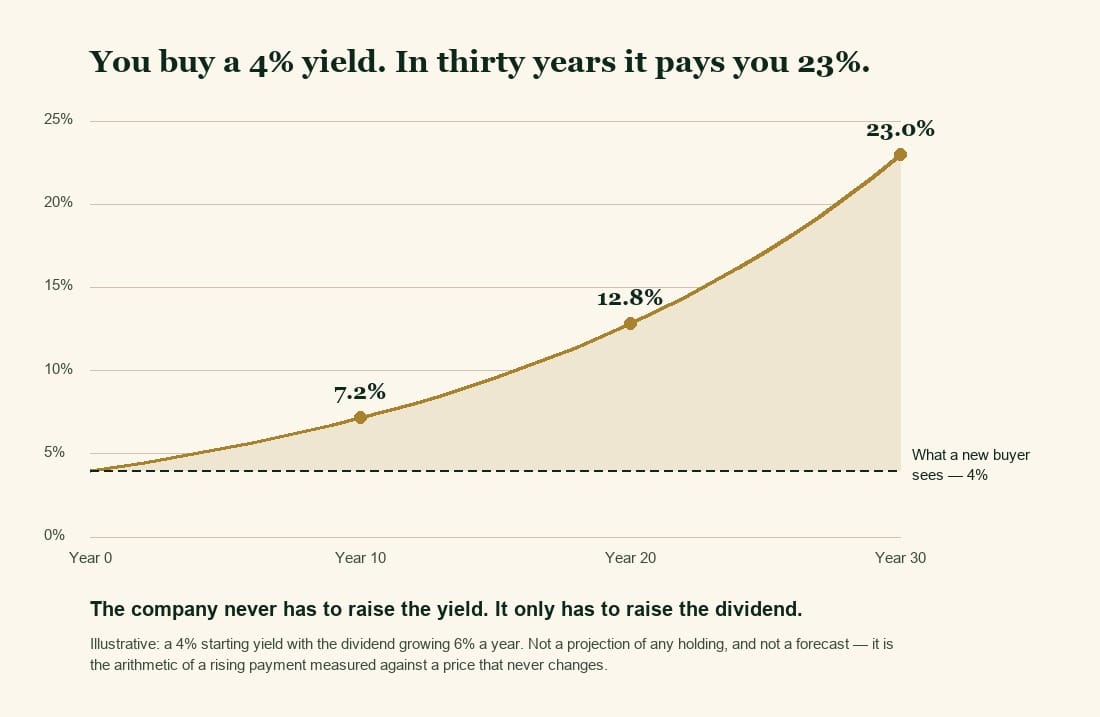
When you buy a dividend stock and hold it, two things happen at once. The dividend rises. And the price you paid never changes. Which means the yield on what you actually paid climbs every single year the dividend goes up. It’s called yield on cost, and over long periods it compounds into something that looks like a misprint.
The company never has to raise the yield. It only has to raise the dividend. Illustrative arithmetic, not a forecast of any holding.
Notice what is not in that calculation: the share price. It could have tripled, or gone sideways, and none of those numbers change. Your yield on cost is fixed by two things only — what you paid, and what the dividend has done since. A new buyer today still sees 4%. You see 23%. Same ticker, different arrangement, and the only variable is when you started.
Now here is what that has actually produced in these portfolios.
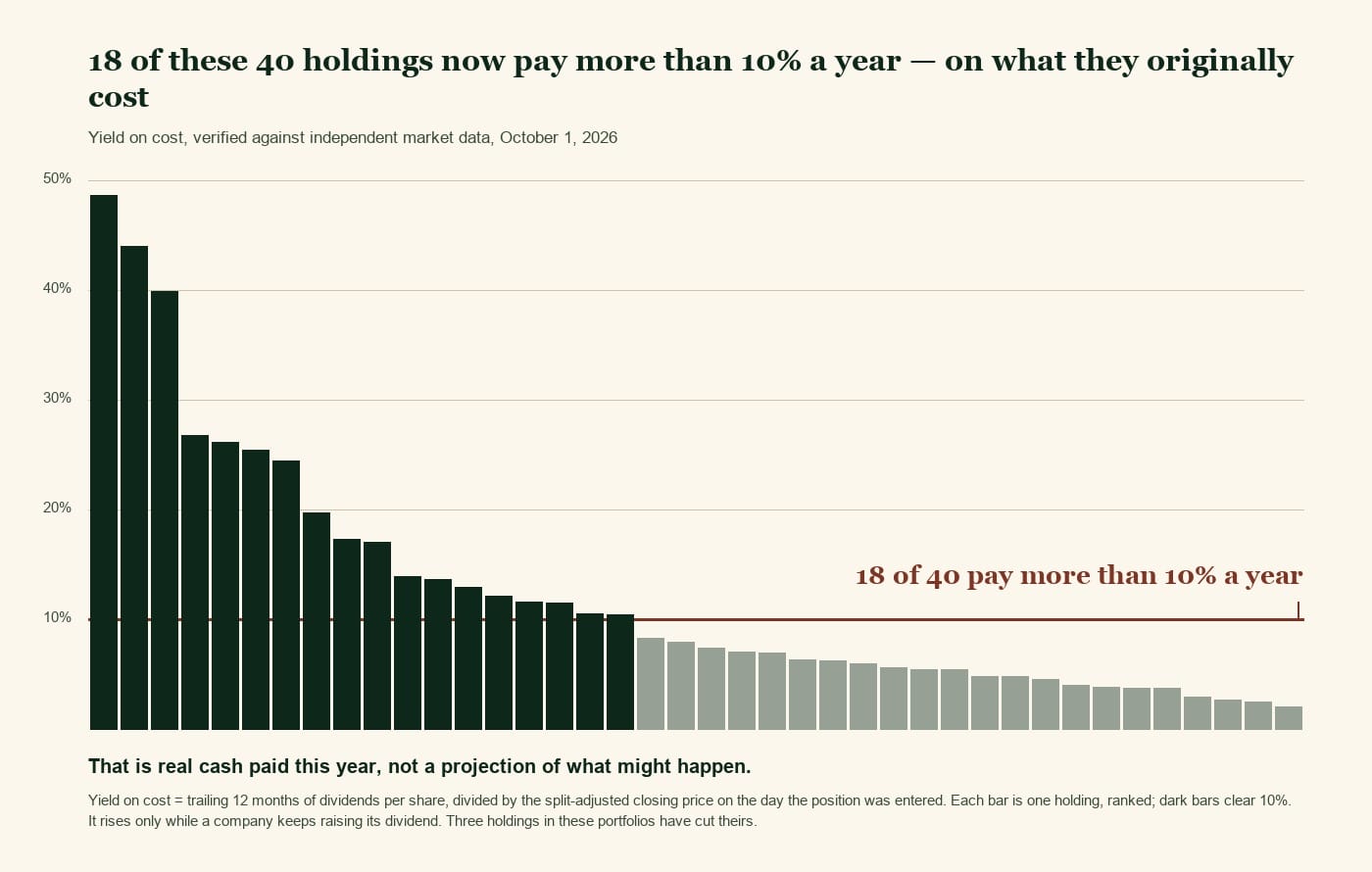
Every bar is one holding in my portfolios, ranked. As of October 1, 2026.
18 of 40 now pay more than 10% a year on their original purchase price.
15 of 40 have returned more than their entire purchase price in cash dividends alone — those positions could go to zero tomorrow and a holder who bought at entry would still be ahead on cash.
The highest pays 48.6% a year on what it cost, on a position held 32 years.
So look at what’s actually on the table here. A regulated monopoly business, with twenty-year contracts signed by the largest companies on earth, spending into a rate base that earns an approved return — and mailing you a rising check the whole way.
Safety. Income. Growth. You are normally allowed two.
Yield on cost is trailing twelve-month dividends per share divided by the split-adjusted closing price on the day the position was entered. It rises only while a company keeps raising its dividend; three companies in these portfolios have cut theirs. Counts are measured across the 40 holdings of the 42 with trustworthy price history back to their entry date, so 18 and 15 are floors. Holding periods run from under a year to 37 years — these are multi-decade results, not annual ones. Figures as of October 1, 2026.
The record
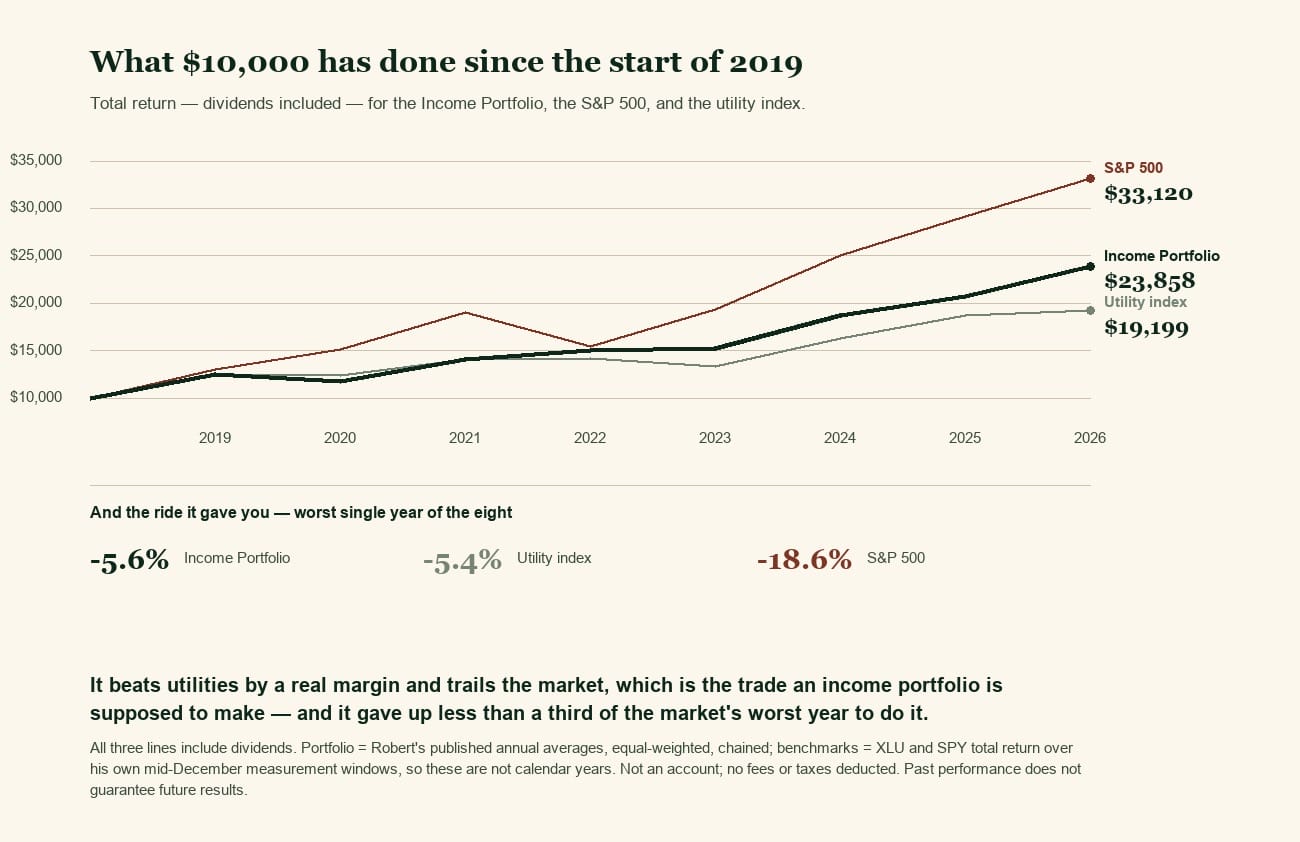
About 12% a year since 2019 — and the worst year was down 5.6%
That is the Income Portfolio, the older and steadier of the two I run. Over the same seven and a half years the utility index it is measured against compounded at 8.9% a year, with its dividends counted exactly the way mine are.
All three lines include dividends. The worst-year strip is the part most letters leave out.
It trails the S&P 500 over that period, and it is supposed to. A portfolio built to fall less in the bad years will not lead in the good ones. That is the trade, and I would rather state it plainly than let you find it out on your own.
And 2020 was a losing year. The Income Portfolio fell 5.6% while the market rose. I wrote that in the year-end review at the time, and I am writing it here, because a record without a bad year in it is a record somebody edited.
Then look at 2022, the year that tells you what these companies are for. The market had its worst year since 2008. The Income Portfolio was up 6.8%.
In the years when everything works, this lags. In the years when nothing works, it is still paying you.
And the market has not finished repricing any of it: these companies still trade close to where they traded when they were growing at zero. You are not late to this. You are early to the part that hasn’t happened yet.
Portfolio figures are the simple average return of the holdings in the portfolio over the review period, equal-weighted — not position-sized or dollar-weighted. Review periods run mid-December to mid-December, not calendar years, and both portfolios were re-sorted in December 2020, so multi-year figures chain baskets that were not identical. Benchmarks are total return over those same windows. No individual subscriber’s account returned these numbers. Past performance does not predict future results. Full disclosure below.
How I try to see a dividend cut before it happens
Every dividend on this page is a promise a company makes with money it has to genuinely earn. Sometimes a company stops being able to keep that promise. The dividend gets cut, the share price usually goes with it, and an income investor gets hurt twice in one afternoon.
So after every earnings season I run every holding through what we call the Early Warning System. It takes a company’s return on equity apart into its pieces, so I can see what is actually driving it: whether the business has genuinely become more profitable, whether it is simply using its assets harder, or whether it has taken on more debt. That last one looks identical to the first in a headline number, and it is the one that kills dividends.
Here is it working, this year, on one of my own holdings.
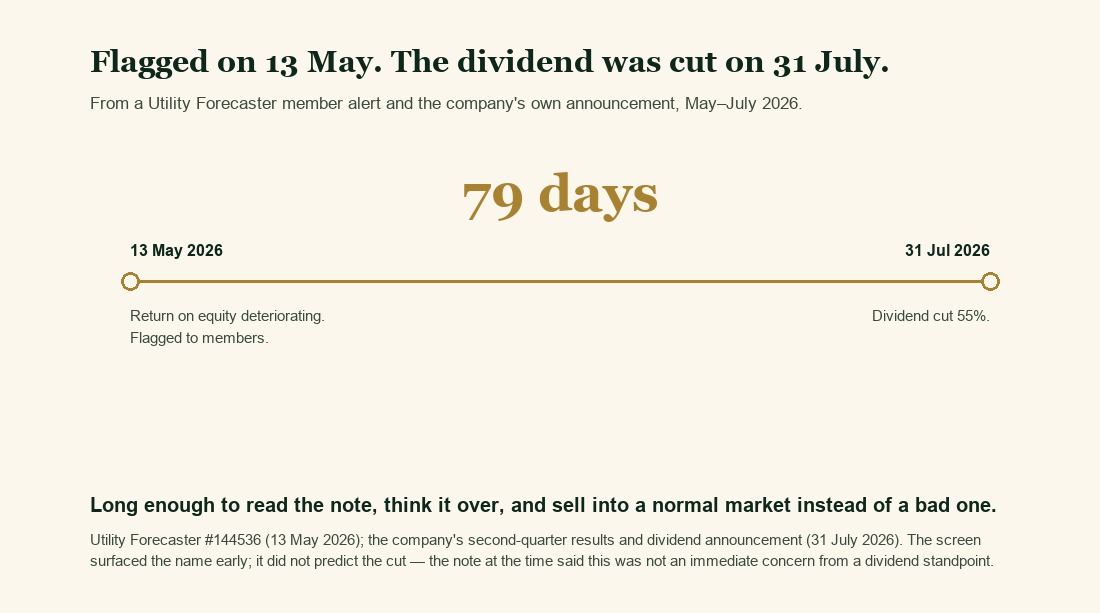
One holding, flagged in May, cut in July. I did not predict the cut — I said the profitability had deteriorated and that I would keep watching.
In May the screen surfaced a telecom operator whose return on equity had gone from slightly positive to negative 11.3%. I wrote that it was not an immediate concern for the dividend, but that it was something I would keep watching. At the end of July the company took a $2.1 billion write-down, cut its outlook, and reset its dividend 55% lower.
Two others came back looking alarming in the same screen and were not — both readings distorted by one-off accounting charges rather than any deterioration in the business. I said that too, and explained why, rather than frightening anyone out of a perfectly healthy company on a bad-looking number.
That is the job. Not pretending nothing ever goes wrong here. Things go wrong. The job is telling you which is which, in writing, before it costs you money.
The confirmation I wasn’t expecting
On August 14, a filing went public and I read it three times
Two things happened this summer that have nothing to do with me.
The first is a filing. On August 14, Peter Thiel’s fund disclosed what it had bought.
Quarter ending
Reported
What it held
September 30, 2025
$74.4 million
Apple, Microsoft, Tesla
December 31, 2025
nothing
—
March 31, 2026
nothing
—
June 30, 2026
$418,666,506
8 positions
He sold out. Reported nothing at all for two consecutive quarters. Then came back at more than five times the size — with roughly 72 cents of every dollar in energy and power, and his first regulated electric utility positions in a filing history that runs back to 2019.
Two of the eight have been in these portfolios for years. One of them since 2004.
Then we read everybody else’s filings too — the full institutional-ownership record for the quarter, checked against the SEC’s own data, ranked by what share of each manager’s own portfolio the position represented. Thousands of managers opened new positions in the power and grid companies I cover; that part is ordinary, because these are companies that sit in every index fund. What is not ordinary is the concentration. The two most concentrated new positions in any of those companies were both his — and both are companies this portfolio already held.
Worth knowing what that is and isn’t: it’s one quarter of one $419 million fund, the universe is the 34 power and grid companies on my coverage list, and a Form 13F discloses long US stock positions only. It is a data point, not a signal, and nobody should buy anything because of it.
The second thing is a merger. On May 18, NextEra Energy announced it was acquiring Dominion Energy for roughly $67 billion — described as the largest acquisition in the history of the American power sector. This portfolio has held NextEra since 2013, and Dominion since April 5, 1989.
Both sides of the table. I didn’t arrange either one — what they tell you is that the repricing I’ve been describing has started, and that the people with the best information in the market are the ones starting it.
As promised
Here’s one of them. Free. Right now.
I said I’d give you a name and a ticker with nothing asked in return.
The company is
Southern Company NYSE: SO
In the Income Portfolio since October 5, 1994 — nearly 32 years.
Put $11,230 into it in October 1994 — and then do nothing at all for 32 years.
What you paid, October 5, 1994$11,230
Cash dividends paid out to you since$58,284
And the shares themselves, today$91,180
Total, without reinvesting a penny$149,464
Had you reinvested those dividends instead$406,900
What it pays each year now, on what you paid26.7%
Read the second line again. It handed back more than five times the purchase price in cash — and you still own the shares. That position could go to zero tomorrow and the money would already be home.
Fifteen of the forty holdings here have now done exactly that. Eighteen of them pay more than 10% a year on what was originally paid for them. The best one pays 48.6%.
It has paid a dividend every quarter for 79 consecutive years. That’s the company’s own language, from its own April 2026 release, and it reaches back to 1948 — through the inflation of the 1970s, the savings and loan crisis, the dot-com collapse and 2008. In April it raised the dividend for the 25th consecutive year.
And the AI build-out landed directly on it. Southern’s Georgia utility has 17 gigawatts of new power under contract. More than 90% of that new demand is data centers — Georgia Power’s own figure, not mine. One of them is that OpenAI campus near Savannah: about $20 billion, 3,200 megawatts, on a twenty-five-year agreement. To serve it, Southern is spending $81 billion over five years — which, remember, is not a cost. It is the base it earns an approved return on, getting substantially bigger.
Southern yields about 3.3% today. The 26.7% is what 32 years of raises did to a 1994 entry price. Yours starts at today’s yield and grows from there. That is the whole engine, and it only runs while you own it.
Go check every figure. Southern is a buy under $97 as I write this, against a price near $91 — and that will not be true forever. When it isn’t, the answer to “what do I buy today” changes.
That’s one of 42. It is not the highest-yielding company in the portfolio, it is not the cheapest today, and it is not the one I’d put new money into first this month.
Southern cost you nothing. The other 41 — what the portfolio paid, what they yield on that, and which one I’d put new money into first — are what the $49 is for.
What you won’t get from me
Let me tell you what you are not getting. I would rather lose you here than have you join and find out in month two.
This is not a trading service
No daily positions, no options, no leverage, nothing with an expiry date. In a typical year the portfolio changes very little. If you want something to do every day, this is the wrong service. Every trade costs you in commissions, spreads and taxes, and doing fewer of them is a feature I charge for.
It will not beat the stock market in a bull market
And it is not designed to. The S&P 500 did better over the last seven and a half years. It also had a year down 18.6% in that stretch, against my worst of 5.6%. That trade — most of the return, a far shallower hole to climb out of — is the entire point. If what you want is maximum return, buy an index fund and stop reading.
It is not protection against a crash
I want to be very clear about this, because our industry lies about it constantly. In 2020, utilities fell further than the S&P 500 and took far longer to recover. Anyone who tells you utility stocks are a hiding place has not looked at the data.
We have losing years, and losing positions
2020 was a losing year. And the worst position I have owned here was a wood-pellet producer that fell roughly 95% before we were out of it. I wrote at the time that I do not intentionally make speculative picks in this letter — because that one was — and that I had kept it to a small share of the portfolio for exactly that reason. Both things were true, and neither made it hurt less.
And nothing here is a guarantee
Dividends are declared by boards of directors, quarter by quarter, and boards can cut them. Three companies in these portfolios have. What I can promise is the screen you just read about — run on every holding, every quarter, whether or not anything looks wrong.
“What if I’m already retired?”
This is the question I get most often, and it is usually asked apologetically, as though it were an admission. It is the most sensible question on this page.
Everything I have shown you so far involves decades. A position bought in 1994. A compounding curve that takes thirty years to reach a number that sounds impossible. If you are sixty-eight, it would be reasonable to read all of that and conclude the arithmetic is for somebody else.
So let me be direct: you are not buying a thirty-year plan. You are buying a payment.
A new position in the Income Portfolio starts at roughly a 4.5% yield. Not in 2056 — next quarter. That payment arrives whether the market is up, down, or closed for the holidays, because it is funded by people paying their electricity bills.
Then it grows on its own. You do not have to time it, or trade around it, or read a single one of my issues to receive a raise. You have to own the stock.
And here is the part that matters more at sixty-eight than it ever did at forty-five. In the worst year of the last eight, this portfolio fell 5.6%. The S&P 500’s worst year over the same stretch was down 18.6%. When you are still working and adding money, a violent year is survivable and occasionally useful. When you are withdrawing, it is the single thing most likely to ruin you: selling into a decline to cover your expenses permanently destroys capital that a recovery can never bring back.
A portfolio built to swing less is not a consolation prize for people who missed the exciting returns. For someone drawing an income, it is the entire point.
You are late to the 26.7%. I will not pretend otherwise — that number belongs to a position bought in 1994 and held for thirty-two years, and anyone who suggests you can have it by 2028 is selling you something. But the 1994 buyer had twenty years of flat demand ahead of them, and still got there. You have the largest expansion in American electricity demand since the country was electrified, arriving at businesses that are permitted to earn a return on every dollar they invest to meet it.
And if it turns out that the compounding runs longer than you do — these are shares. They pass to whoever you leave them to, still paying, still raising. That is not a morbid thought. It is the most ordinary form of wealth there is.
Your membership
What you get today
You have been reading about one company. Here is the whole file it came out of — and six reports that are yours to keep whatever you decide.
Report one $99 value
The Incredible Dividend Map: Where Stocks Yield Up to 48.6% on Every Dollar Invested
The other 41. Every holding, the city it runs out of, what it has returned since we bought it, and what it now pays on the money originally invested.
Report two $99 value
Robert’s 2026 Essential Income Portfolio
Your income portfolio, pre-built. The ten companies I would buy first if I were starting from nothing today, with what to pay for each.
Report three $99 value
The Infrastructure Opportunity
Where the 2026 income is headed, and why.
Report four $99 value
5 Utilities for AI Power Demand
The supply side of the AI story — the companies almost nobody is buying.
Report five $99 value
The Dividend Compounding Blueprint
How to turn today’s yield into double-digit income on cost, step by step. The yield-on-cost section of this letter, worked out in full.
Report six $99 value
The Build Order: What to Buy First, at Your Size, Over Twelve Months
The answer to the question I get more than any other. Three plans — $10,000, $50,000 and $250,000 — naming which positions to open, in what order, at what size, in four quarterly instalments, so you are not buying the whole portfolio at one morning’s prices. Built from the buy-under limits and the rankings — and when even a top-ranked company is trading above its limit, the plan leaves it out and tells you why. That is the rule doing its job.
Six reports · $594 of research, included free with a $49 membership.
And then the service itself, which is the part that keeps working after you have read them.
Within five minutes — both portfolios, with every price limit
All 42 dividend-paying companies across the Income and Growth portfolios: what we paid, what each yields, and the buy-under price above which I tell you to stop buying — the number that answers “is today a good price, or did I miss it?” Plus the five-position fixed-income sleeve.
5 min
Tonight — How They Rate, and the Safety Rating System
My rating on nearly 390 essential-service companies — not the 42 we own, the whole sector — each with a safety score for the strength behind its dividend. Which means the first thing you can do, before buying anything at all, is look up every utility, pipeline and telecom you already own and see what I think of it.
Tonight
Every month — the Best Buys list, force-ranked
Every holding ranked by what I would put new money into first this month. Not 42 names to sort through. A running order, with the top of it named. If you only ever read one thing I publish, read this.
Monthly
Every week — the issue, plus alerts when something moves
What changed, what I’m doing about it, and why: rate cases, earnings, dividend increases, and any revision to a buy-under price. Urgent portfolio updates between issues when a position needs your attention. Everything archived, so you can read backwards as far as you like.
Weekly
Every quarter — the Early Warning System, on every holding
The screen described above, run after each earnings season on all 42, whether or not anything looks wrong — and published either way, including the times it flags something that turns out to be an accounting artifact.
Quarterly
I’ve measured the Best Buys list against its own portfolio in the three years I can document fully. It won all three: Growth Best Buys +38.6% against the portfolio’s +27.6% in 2019, and +27.1% against +14.7% in 2024; Income Best Buys +26.6% against +22.8% in 2024. That is the record I can document, and it is the record I’ll show you.
“[Utility Forecaster gives me a] complete summary of the key elements that allow me to consider a [position] in that security — even though I do not always agree with your opinion.”
90 days to change your mind, in full. You keep all six reports either way.
Your price
$49 — and what the same job costs everywhere else
$49 for your first year. The regular rate is $99, which is what it renews at — automatically, charged to the card you use today, with an email before it happens and one message to cancel.
Here is what the same job costs everywhere else.
A fee-only advisor charging 1% manages $500,000 for about $5,000 a year — and almost certainly doesn’t specialize in this sector. An hour of a planner’s time, to answer one question about position sizing, runs $250 to $400.
A retail dividend-safety data subscription runs about $399 a year, covers the whole market shallowly rather than this sector deeply, and gives you inputs. You still have to do the work, and at the end of it you still don’t know what to buy.
Our own published rate is $99. Today it’s $49.
Regular Rate · 1 Year
$99
12 months · our standard membership rate
Both portfolios, with every buy-under price
Weekly issues, plus urgent portfolio updates
The monthly Best Buys list, force-ranked
How They Rate — nearly 390 companies, with Safety Ratings
The Early Warning System, run every quarter
90-day money-back guarantee
The six reports ($594 value) not included
New-member rate · save 50%
Your First Year
$49
12 months · less than a dollar a week
Both portfolios, with every buy-under price
Weekly issues, plus urgent portfolio updates
The monthly Best Buys list, force-ranked
How They Rate — nearly 390 companies, with Safety Ratings
The Early Warning System, run every quarter
90-day money-back guarantee
Plus, included free: all six reports — a $594 value
Start your membership
$49 for your first year · all six reports included · 90-day money-back guarantee
Please read this before you order. Your membership is one full year of Utility Forecaster for $49. After that first year it renews automatically at $99 a year, charged to the card you use today. We email you before that happens, and you can cancel any time — one message to customerservice@investingdaily.com does it. If you cancel inside the first 90 days you get every dollar back and you keep all six reports.
Here’s the only hurdle that matters: does a year of this research cause you to own $1,100 more of the right companies than you otherwise would have?
At the Income Portfolio’s current yield of about 4.5%, one position that size pays about $49 a year — and it pays it again the year after, and the year after that. One modest holding, in one company, that you wouldn’t have found on your own, and the membership has covered itself permanently.
Note what I am not telling you. I’m not telling you that $1,100 of dividends “pays for” the membership — those dividends would be yours, and you could earn them in an index fund without me. The question isn’t whether your money can produce $49. It’s whether I can improve where you put it by more than that.
And if you’re moving real money, run it at your own size. On $250,000 at 4.5%, you’re deciding where about $11,000 a year of income comes from. On $500,000, about $22,000. Against a decision that size, $49 isn’t a purchase. It’s a rounding error on one quarter’s income, spent on getting the allocation right.
That’s the whole case. One position, out of 42, out of nearly 390 I rate.
Ninety days, and you keep everything
Take 90 days with it. Read the issues, look at the portfolios, check every figure in this letter, follow a few positions and see whether I’m any good at this.
If it isn’t for you, email customerservice@investingdaily.com or call (800) 832-2330, 9:00 a.m. to 5:00 p.m. Eastern, Monday through Friday, and we’ll refund every penny. All six reports, the ratings, the issues — they’re yours regardless. There is no version of this where you’re out $49. Either you keep the membership because it’s worth it, or you get the $49 back and keep the research anyway.
Investing Daily, its employees and its contributors may hold positions in securities named here. This is research, not personalized advice.
Questions people ask before they join
What actually arrives, and how?
Within about five minutes of ordering: all six reports, both portfolios with every buy-under price, and access to the members’ site including How They Rate. Then the weekly issue, portfolio updates between issues when something needs your attention, and the Best Buys list every month. Everything is archived, so you can read backwards as far as you like.
Do I need a large portfolio for this to be worth $49?
At the Income Portfolio’s current yield of about 4.5%, roughly $1,100 of capital covers it in dividends. Below that it’s still worth it for the How They Rate ratings on the utilities and telecoms you already own.
Is this a lot of buying and selling?
No. The typical holding has been in the portfolio long enough to return about 185% in total. The oldest has been there since 1989. The work is deciding what to buy, and when to stop.
What happens at renewal?
Your first year is $49. It renews automatically at $99 a year, charged to the card you use today. We email you before that happens, and one message to customerservice@investingdaily.com cancels it.
Can I speak to a person?
Yes. Investing Daily’s customer care is staffed by real people in the United States: customerservice@investingdaily.com or (800) 832-2330, 9:00 a.m. to 5:00 p.m. Eastern, Monday through Friday.
What happens to my email address?
You get Utility Forecaster, and notices about Utility Forecaster. We’re part of Investing Daily, so you’ll occasionally hear about our other publications — and every one of those has an unsubscribe link that works on the first click. We don’t sell your address outside the company. If the volume ever annoys you, one message to customerservice@investingdaily.com turns it off without touching your membership.
Is there an upsell waiting once I hand over a card?
We publish other services and some cost more than this one. You’ll hear about them. Your $49 buys the full Utility Forecaster membership described on this page — nothing here is held back for a higher tier, and nothing here stops working if you never buy anything else.
What if I read it and it isn’t for me?
Ninety days, every penny back, and you keep the six reports and everything you’ve downloaded. Same address, same phone number.
Why this month, and not next year
There are three real costs to waiting, and you can verify all three.
01
The repricing is early, not over
These companies still trade close to where the market priced them when they were growing at zero. The contracts that change that were signed in the last two years and run for two decades. The capital that changes it is being approved in state commissions right now. You are not late to this; you are early to the part that hasn’t happened yet.
02
The clock starts the day you buy
Every yield-on-cost figure in this letter is a function of exactly one variable: how long the position has been held. 26.7% is 32 years of dividend increases divided by a 1994 price. There is no way to buy that retroactively. A year spent thinking about it is a year that never counts — and that is the one argument here that gets stronger the older you are.
03
The limits are published, and they move
Southern is a buy under $97 as I write this. That is a fact with a shelf life. If it is over that limit by the time you read this, I have just told you not to buy it — which is the entire point of publishing a limit rather than a recommendation.
Everything arrives in about five minutes · 90 days to change your mind, in full
What happens if you buy an essential-service company and simply never sell it
Everybody in this business talks about what to buy. Almost nobody will tell you what happens next.
The typical holding in these portfolios now pays 7.7% a year on what it originally cost. Fifteen have already returned more than their entire purchase price in cash.
That isn’t a forecast and nobody is promising you’ll repeat it. It is what is in the ledger. It is also not a smooth ride — when the market breaks, these break too. What they do is keep paying you while it happens, and raise the payment while you wait.
So here is where it stands. A monopoly business, allowed to earn an approved return on every dollar it builds. $1.4 trillion of building already scheduled, into companies the market still prices as though nothing ever would be. And a dividend that rises the entire time it happens.
Safety. Income. Growth. From the same shares. You are normally allowed two.
The whole file costs $49 — and here is exactly what happens when you order. Everything arrives within about five minutes: all six reports, both portfolios with every buy-under price, and my rating on nearly 390 companies. Your first weekly issue comes this Friday. If you decide inside ninety days that it isn’t for you, one email or one phone call and the $49 comes back — and every report, every rating and every issue you’ve received stays yours.
There is no version of this where you are out $49.
Which leaves exactly one cost on the table, and it isn’t the $49.
Every figure in this letter is a function of one variable: how long a position has been held. That clock starts the day you buy. Not the day you decide.
Start yours today.
Robert Rapier
Chief Investment Strategist · Utility Forecaster
“Thanks to the team for helping me through the last 35 years. We have done well.”
Dan Fisher · subscriber, February 2026 — a member since 1991
P.S. Southern Company cost you nothing. The other 41 — what the portfolio paid, what they yield on that, and which one I’d put new money into first this month — are what the $49 is for. They are in The Incredible Dividend Map, which is the first of the six reports, and it is yours to keep even if you ask for the $49 back.